Dear Reader, should you wish to know the true state of one’s romantic fortunes, look not to whispered compliments or stolen glances—but to the dance card, where society’s judgments were recorded in pencil and rarely erased.
One might assume a dance is simply an evening’s diversion—but Texans have always known better. In the ballrooms of the 19th century, every waltz was a negotiation, every quadrille a quiet test of one’s prospects, and nothing revealed social standing quite like the dance card. Small enough to fit in a jacket pocket, it nevertheless carried the emotional weight of an entire season.
Dance cards—small booklets that rose to popularity at balls and formal dances throughout the 1800s—served both as documentation and keepsake. Most often carried by women, they listed the evening’s dances in orderly sequence, each accompanied by a blank line where the name of a prospective partner might be penciled in. In this way, a lady could track her suitors and the order in which she agreed to dance with them, all beneath the approving gaze of chaperones and the steady rhythm of the orchestra. Decorative as well as practical, these cards were typically fashioned from paper, cardboard, or even thin wood. Some were hand-adorned, others printed and embossed, embellished according to the stylistic tastes of the era—delicate ribbons, gilt edges, floral motifs—each one a small work of art meant to be treasured long after the final tune had faded.
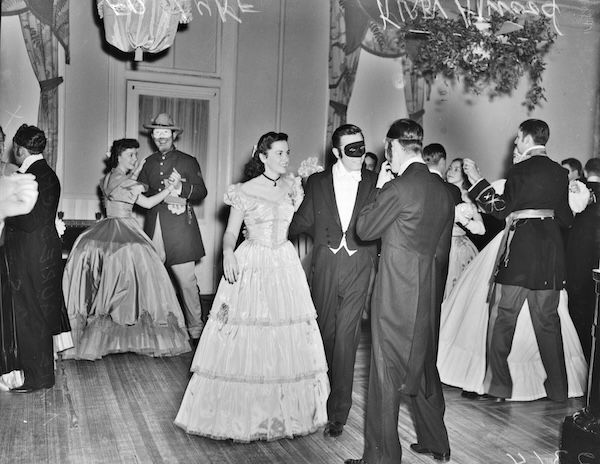
Before the music began, young men—and women—filled their cards with great care and even greater calculation. To secure an early dance suggested eagerness (or confidence); to fill the remaining spaces later in the evening hinted at strategy; and to carry a card with too many empty lines required patience—and a good deal of charm. When the night ended, the card often told a fuller story, annotated with private observations on graceful turns, lively conversation, missteps both literal and social, and whether a particular partner deserved a repeat engagement or polite avoidance.
Among Texas’ German communities, dance cards reflected a courtship tradition built on order, expectation, and impeccable timing. Romance unfolded in full view of the room, yet remained carefully controlled, with every dance signaling interest without ever stating it outright. In many ways, these cards served as an early social ledger—part planner, part diary, and part gossip column, minus the printing press.
The dance cards currently on view date to the 1890s and offer a delightful twist on expectation: they belonged to Mr. Walter Jenull. Their survival reminds us that men, too—even German Texan gentlemen—participated in this carefully choreographed tradition.
A review of nearly twenty of Mr. Jenull’s cards reveals curious patterns. Most notably, he appeared to avoid the waltz; those lines were frequently left blank. Yet one card stands apart. On that particular evening, he danced three times with a Miss Elmendorf—the first dance, the last dance, and, intriguingly, a waltz in between. It is the greatest number of dances we have recorded him sharing with any one partner. A couple of years later, the penciled name in the margins became a permanent one: they were married. ❤
Several of the dances were held in a building known today as the Bonham Exchange. In the late 19th century, it served as a Turnverein—a German social club dedicated to community, culture, and physical recreation—where evenings of music and measured courtship played out beneath high ceilings and watchful eyes.