A’ Hurlin’ in South Texas
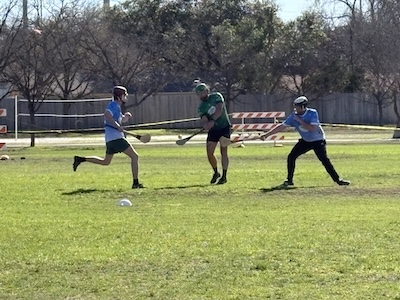
On a Saturday afternoon at Raymond Rimkus Park in Leon Valley, Texas, the crack of wood against leather cuts through the air. A small yellow ball rockets the length of a soccer field. It clears a cluster of players and sails into the net. Goalkeeper Kevin McManus laughs in disbelief, staring back at his friend Adrian Brett, who just scored on him from the opposite goal line.
“Now I’ve got to go score on the blighter!”
Hurley in hand, he charges forward.
This is hurling, one of Ireland’s oldest and fastest field sports, being played in South Texas. For the men and women of the San Antonio Gaelic Athletic Club, it is far more than a game.
An Ancient Game, A Texas Pitch
Three thousand years ago, hurling took shape on the green fields of Ireland. When the Irish sought their fortunes in the New World, they carried their traditions with them.
Hurling is a sport of speed and precision, where players carry a wooden stick called a hurley and strike a hard leather ball, the sliotar, either into a goal for three points or over the uprights for one.
It’s often described as a variation of field hockey or lacrosse. Traditionally played with 15 players per team, on a field longer and wider than a soccer pitch, hurling demands agility, stamina and nerve. Players can catch the ball midair, carry it in hand for four steps, balance it on their hurley while running, pass by hand or strike, and shoot on goal in a blur of motion.
A Name with a History
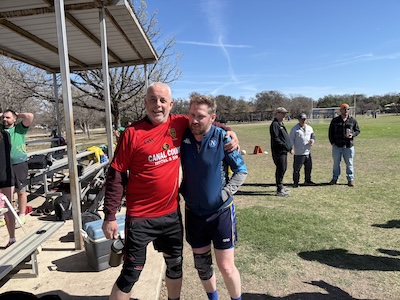
The San Antonio Gaelic Athletic Club formed in 2011 as a small group of people, passionate about Irish games. Some members were Irish-born. Others were Irish American. Some simply fell in love with the team culture. They all found something meaningful in keeping the game alive.
The club took a team name of the “San Patricios,” an homage to St. Patrick’s Battalion, a group of Irish soldiers who fought under the Mexican flag during the Mexican-American War. Disillusioned by anti-Catholic and anti-Irish prejudice in the U.S. ranks, they chose to side with Mexico, finding shared faith and identity across borders.
In Texas history, the San Patricios represent layered loyalties and complex belonging. For the modern team, the name is both homage and statement. It acknowledges that Irish identity in Texas has never been simple or singular. It has always adapted, responded, and taken root in new soil.
More Than a Match
With resolve and determination, the club adapts the Raymond Rimkus soccer field into a hurling pitch and plays their weekly match. The uprights are improvised with PVC plumbing pipe attached with duct tape to the soccer goals. The park’s field is smaller, and the teams are too - six players to a side.
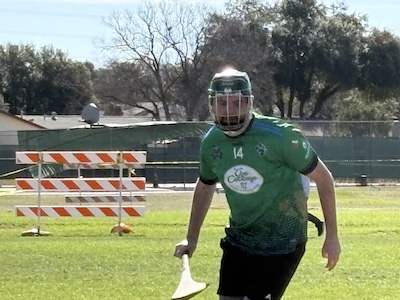
On game days, members pull on green or blue jerseys bearing their numbers and local sponsors, including the San Antonio Harp & Shamrock Society and The Cottage Pub on Broadway. It’s an amateur club, but it brings intensity. There are fast breaks, contested catches, hard strikes, and fencing for the ball. But at the end of the day, the score rarely matters. There is no stadium crowd nor a professional contract on the line. Sometimes there’s no official clock. What matters is that the game is played.
Over the past 15 years, the San Patricios have grown, waned, and grown again. Members have moved away. New players have joined. In some families, children who once watched from the sidelines are now old enough to step onto the pitch themselves. Today’s roster has 35 active players.
Adam O’ Riordan and Aisling Costello moved to San Antonio in 2024. Irish-born, they’re both professors at local universities, Adam in psychology at UT San Antonio and Aisling in psychology at Schreiner University, Kerrville. After meeting some hurlers at an Irish heritage event, they decided to join the team.
“Although we hadn’t played hurling or Gaelic football since we were children, they convinced us to come along to training,” Adam said. “For us, it has been a great social outlet and we have formed some great friendships. It also gives us a sense of home once or twice a week -- keeping us connected with a bit of humour, with other first- and second-generation Irish in the area.”
Keeping Culture in Motion
This Irish Heritage Month, as we reflect on the many ways Irish Texans have shaped our state. The San Antonio Gaelic Athletic Club reminds us that culture is not static. Not only is it preserved in documents, place names, empresarios, monuments and maps, but also in music played at a corner pub, dance steps learned by a second generation, language classes, festivals, parades and in the swing of a hurley on a Texas pitch.
For Irish Texans far from the Emerald Isle, hurling offers an understanding of something ancient they’ve carried forward. The continuity of a 3,000-year-old tradition is the real victory.