The Institute of Texan Cultures has been part of The University of Texas at San Antonio since the 1970s, serving not just as a museum, but also as a bridge between the classroom and the workforce.
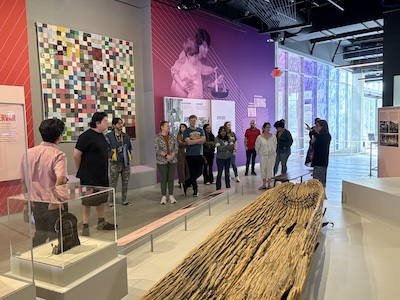
Since the institute’s recent reopening, the ITC has been collaborating with several faculty from different disciplines and their students, allowing them to use the museum as a hands-on learning laboratory where they can gain real-world skills through career-engaged learning.
“These types of collaborations are central to the ITC’s mission and to UT San Antonio’s classroom-to-career vision,” said Monica Perales, associate vice provost for the ITC. “By working alongside faculty and students, the institute creates opportunities for applied learning that extend far beyond traditional coursework. We’re helping students envision the many career paths they can pursue.”
The ITC is piloting a collaboration with a community translation course led by Melissa Wallace, PhD, associate professor of Translation and Interpreting Studies and director of the Graduate Certificate in Translation & Interpreting Studies, allowing students to help expand the museum’s Spanish translations on the exhibit floor, while growing the institute’s role as a cross-disciplinary partner in student learning.
Spanish translations are a key part of the exhibits, which feature both the English and Spanish text throughout the space. The museum’s emphasis on bilingual interpretation made it a natural partner for Wallace’s course.
Students from the course are creating Spanish-language translations of gallery tours. At the end of the semester, they will lead their own tours in Spanish during a special friends-and-family event, applying what they learned in the classroom in a public, professional setting.
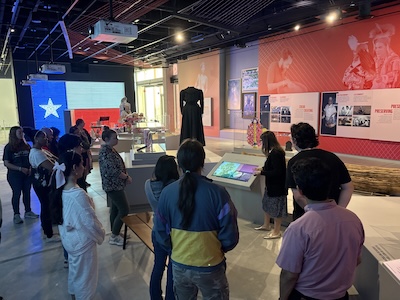
“Through collaborations like this one, students gain hands-on experience that employers increasingly value, including project-based work, cross-sector collaboration, and the ability to communicate across cultural and linguistic boundaries,” Wallace said, “Just as importantly, they begin to see themselves as professionals and contributors to their community.”
While Wallace’s class is creating Spanish tours, another is developing portable exhibits for school classrooms.
The Interdisciplinary Project Based Learning class, which is being co-taught by Marissa Munoz, PhD, assistant professor in the College of Education and Human Development and ITC education curator Liz Lopez is developing curriculum for the institute’s Texkit program. These portable exhibits bring the museum experience into classrooms through lessons, hands-on demonstration objects, and supporting resources.
The students began developing the curriculum after their course integrated readings, field trips to the ITC, and project-based activities. They also examined artifacts from the institute’s demonstration collection, which included about 15-20 musical instruments.
The museum also recently hosted students from UT San Antonio’s Introduction to Public History class, taught by Omar Valerio-Jiménez, PhD, professor of history.

Jiménez brought his graduate certificate class to the ITC to see how classroom concepts translate into professional museum practice and to help them better understand potential career paths in public history and cultural institutions.
A presentation by Perales gave students insight into the behind-the-scenes work at a museum and how staff members bring multiple skill sets together to take an exhibit from concept to reality. By walking through real-world constraints, such as budgets, space limitations, and curatorial decision-making, the students gained a clearer understanding of the practical challenges they may encounter in museum careers.
“I wanted students to visit a museum to speak with the staff to learn how exhibits are constructed, the financial and physical limitations imposed on exhibits, and the choices that are made in creating such exhibits,” Valerio-Jiménez said. “Having Dr. Perales speak to the students about some of these constraints was very useful.”
Valerio-Jimenez explained that public history students approach museum exhibits with a more informed perspective than the typical visitor. Seeing the exhibits in person allowed students to analyze and critique museum content as part of their coursework and to build the critical thinking and evaluation skills essential for careers in museums, historic sites, and other public-facing history roles.
In addition to these course-based collaborations, the museum continues to support student success through hands-on internships in collections, education, and exhibitions, giving students direct pathways from classroom learning to professional experience.
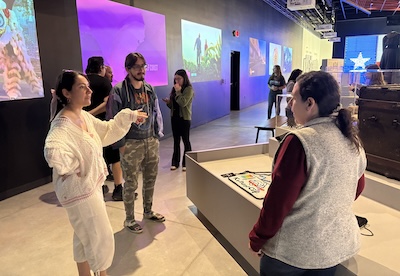
For students like Denali Gonzalez, a 2026 art history and criticism major, her internship became a defining step in her career path. As a curatorial intern in the museum’s collections department, Gonzalez played a key role in preparing artifacts for display in the museum’s new space.
“The ITC team has given me opportunities to explore different roles, like collections, exhibits, and education,” Gonzalez said. “That experience has shown me how every part of a museum comes together to tell a story.”
Through her internship, Gonzalez gained hands-on experience handling artifacts, preparing condition reports, and learning preservation techniques—skills that have helped shape her goal of pursuing a career in art conservation.
Stories like Gonzalez’s show how the ITC functions as more than a museum. It is a dynamic training ground where students build professional skills and engage meaningfully with the community.
“The ITC is an essential partner in supporting student success,” Perales said. “We are a laboratory where students from a wide range of disciplinary backgrounds can take the lessons they learn in the classroom and apply them in tangible ways. What they do here matters, not just for their futures, but for the communities we serve.”
Explore Further
Learn more about Denali Gonzalez’s museum experience.
Find out how the Institute of Texan Cultures offers hands-on learning for every age.