The People's Music, The People's Stories
Generations of San Antonians have handed down a story about a man at a pachanga who amazed guests with his dancing. Ladies lined up to be his partner for the next number, but everything changed when one party guest looked down and saw this mysterious dancer’s bird-like legs.
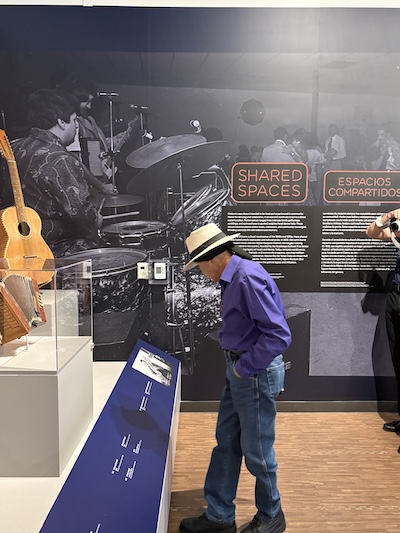
Prompted by the artifacts and images around him, Roger Hernandez spent the opening reception for the Institute of Texan Cultures' new exhibit, “Puro Conjunto: Border(less) Sound” recalling tales like that one. Hernandez is the president of the Totally Tejano Hall of Fame and Museum, which is mentioned in the exhibit as an active contributor to preserving the region’s musical cultural heritage.
His stories, part history and part folklore, captured exactly what the Institute of Texan Cultures hopes visitors discover in the exhibit: that conjunto’s legacy lives not only in instruments and photographs, but also in the memories and conversations passed from one generation to the next.
Hernandez had no shortage of folktales for anyone within earshot.
“The devil appearing at the Camaroncito nightclub – it was not on Halloween – it was on an off night. And the people said, after he was caught dancing with a girl and she collapsed, he left the smell of sulfur. And then he ran, the story says. He ran to the restroom and escaped through the window.
“About a week later, I went to go get my haircut with the owner – his name was Ray Gonzalez – the owner of El Camaroncito. He had a barber shop on Castroville Road. And he said, Roger, that's not true, that he went to the restroom and escaped through the window. I don't have any windows in the restroom.”
As Bianca Alvarez, the institute’s head curator, stopped to visit with Hernandez, he pointed across the gallery, where an upright bass stood in a corner, and spun another yarn.
He recalled Jimi Hendrix crediting a San Antonio musician for inspiring his famous guitar-burning performances. Hernandez identified that bassist as Juan Viesca. According to the story, Viesca coated the back of his upright bass with wax the night before a performance, then sprayed it with lighter fluid before igniting it during the finale.
For Alvarez, those stories became part of the blueprint for “Puro Conjunto.” Rather than simply displaying instruments and photographs, the exhibit team sought out families, organizations, community spaces, and people whose lives intertwined with the musicians who built conjunto. Forming relationships opened new avenues and led to the stories and objects now on display.
For the Next Generation
Alvarez explained that conjunto’s history stretches back to the late 1800s. Many of its pioneers, such as Narciso Martínez, Lydia Mendoza and Bruno Villarreal, were some of the earliest recorded performers. The next generation – the Texas Tornados era – is slowly fading with the passing of Flaco Jiménez and Augie Meyers.
“But the tradition carries on with the next generation of musicians that continue to innovate this living genre—with conjuntos forming as far away as Japan,” Alvarez said. “San Antonio, specifically, has been incredibly dedicated to the cultural preservation of this powerful expression. From community organizations to college curriculum, Texas has been the first state to institutionalize formal training in the genre and its principal instruments, securing conjunto’s future and legacy.”
One artifact on display literally bridges generations of conjunto musicians. Yadhira Lozano, director of San Antonio’s Luminaria arts festival, had been holding on to a bajo with signatures from Flaco Jiménez, Augie Meyers, Max Baca and the Texmaniacs. Lozano saw an opportunity one night in Gruene to have her guitar signed with the plan of raffling it off as a fundraiser to support the arts festival. The deaths of her father and, later, Flaco Jiménez and Augie Meyers, transformed the bajo from a fundraising item into an artifact of lasting significance.
“It was supposed to be raffled for the Luminaria Festival,” Lozano said. “And that year my, my dad passed away. I told Max, I don't have the energy to figure out how to do justice to it right now. I was going through all that and the festival's a month later. I'm not ready to just auction it off to the highest bidder. It's too special.
“Then Augie just passed away and now this needs to be in a museum. I come from the museum world, so I called some of my former colleagues and I'm like, where do you think would be the best place for it? The Smithsonian – Flaco’s accordion and Max’s bajo are at the American History Museum already. I'm not going to auction it. It has to be somewhere important.”
Remembered and Honored
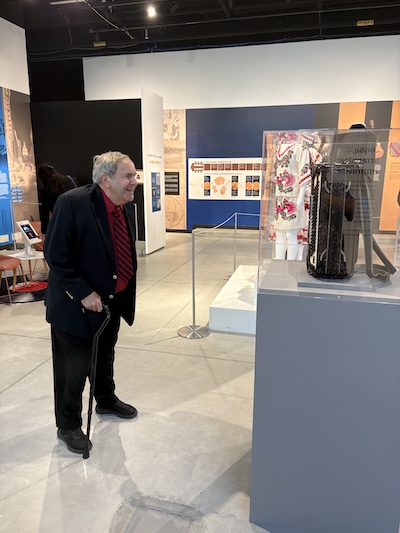
The case across from the autographed bajo holds another artifact invested with the memory of a conjunto stalwart: a Hohner accordion that belonged to Bruno Villarreal. Clayton Shorkey, Ph.D., president of the Texas Music Museum Archive in Austin, loaned it to the institute for this exhibit, marking the first time the artifact had left its home institution for public display.
Shorkey and members of his museum staff made the trip to San Antonio for the reception. Shorkey beamed with energy and excitement as he guided guests through the exhibit, pointing out artifacts on display and sharing first-hand experiences of meeting and working with the pillars of conjunto music, including Bruno Villarreal.
“Robstown was the last place that we knew that he had lived,” Shorkey said. “We went to the house, which was empty. And then this little kid said, his family's down the street. They took us there walking us like a Pied Piper down the street and they said, no, he's in a nursing home. And they took us.
“It was so wonderful to see him. And he became a big star after that. Nobody really knew who he was. And, oh my goodness, the next time we went back, we brought him an accordion. He used the piano accordion – he was influenced also by Italian music as well as the German button (accordion). When we went back, television people, everybody came and then we kind of adopted him.
“We talked to him and all the staff came around and we said, oh my goodness, don't you know who this is? And then I asked him, how do you like it here? And he said, ‘oh, they treat me so mean.’ You should have seen the faces of that staff. Of course, he laughed. He's just a real jokester. It was amazing. It was really lucky to get to know him.”
Shorkey and the Texas Music Museum Archive also loaned performance dresses belonging to Mendoza and Beatriz Llamas, along with other historic images and artifacts.
The Soundtrack of South Texas
“Conjunto emerged from shifting borders and working-class people,” Alvarez said. “This exhibit was built from the stories and objects that families, friends, and communities have preserved and sustained, giving us the honor and opportunity to share and celebrate their contributions. Conjunto is the soundtrack of our region — a musical mestizaje that is uniquely Texan.”
“Puro Conjunto: Border(less) Sound” will remain on display through May 30, 2027. The institute will schedule additional programming for the exhibit, and additional material will be published through the museum website and social media outlets, @texancultures on most platforms.
The Institute of Texan Cultures is open Thursdays through Sundays, 10 a.m.-4 p.m. Admission is $10 for adults, $5 for youth, seniors and military with ID, and free for UT San Antonio students, faculty and staff. For more information, visit TexanCultures.utsa.edu.