Shelly Lares on the sounds, traditions and future of conjunto.
Shelly Lares, a.k.a. “Little Miss Dynamite,” began performing professionally at age 10 with Orquesta Hot Talames. At 17, she began touring, launching a 40-year career that took her around the world and included more than 25 albums. Now retired from the stage, Lares is the first Artist-in-Residence at UT San Antonio, where she mentors students, produces music and teaches the traditions that connect conjunto, orquesta and progressive Tejano.
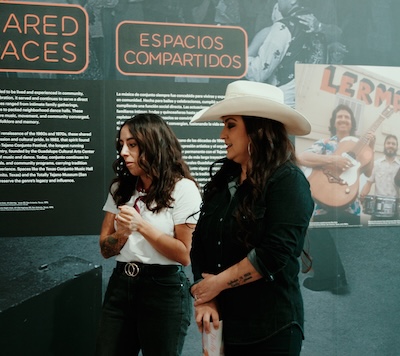
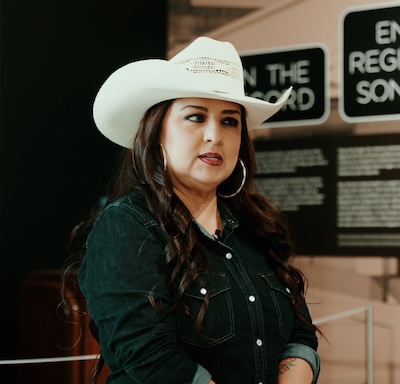
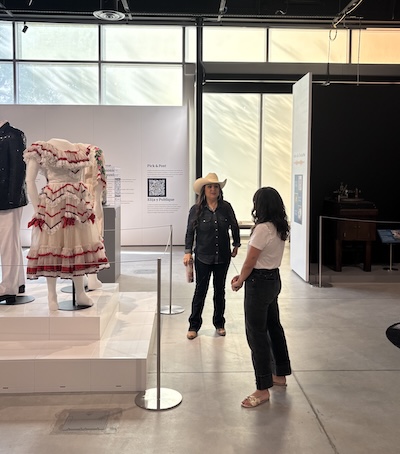
The Institute of Texan Cultures recently had an opportunity to welcome Lares for a tour of the "Puro Conjunto: Border(less) Sound" exhibit. We asked for her perspective on conjunto as someone who grew up surrounded by music, built a career in the industry and is now helping pass those traditions to a new generation.
While we set out to understand what conjunto sounds like today, Lares' lived experience revealed something deeper: a story about family, culture and the traditions passed from one generation to the next.
The following is a transcript from our conversation.
What is conjunto?
Conjunto, to me, reminds me of the great-grandfather of where we are today. It started as a beautiful foundation, not only musically but culturally as well. It really resembles who we are as Mexican Americans and the music that I represent.
To me, it's also a culture. It's in the food we eat. It's in how we are with family, how family-oriented we are, our morals, our respect for our grandparents and parents, and gathering at family functions. That's really how it originated. You had someone picking up an accordion after probably working on the farms and playing corridos or whatever they were influenced by. You had German polkas, and then you had our Mexican upbringing brought into the mix.
That's why it's difficult when people ask me, "What is conjunto?" My answer is often, "What isn't it?"
We are such a beautiful combination of so many things, and we're the only ones in the world that do it. That's what sets us apart.
There wouldn't be orquesta and there wouldn't be progressive Tejano if there wasn't conjunto. Just as I wouldn't be here if it weren't for my parents, my grandparents and my great-grandparents. That's how I see music. It's a family timeline.
Is conjunto defined by particular instruments, cadence or musical characteristics?
It's all of those things. It's stylistic. It's cadence. It's how you're playing. It's instrumentation.
I wouldn't particularly say it's the person playing it. I don't feel like somebody has to pick up an accordion to qualify. I think sometimes we try to identify ourselves so people who don't know us can understand who we are, and I get that.
But from a musician's standpoint, I think it's more about listening. What I hear is what it is to me. I let the music speak for itself. I don't try to tell people they can't be conjunto or can't be Tejano, because other genres have been fair to us and we've borrowed from them too. It can't be a double standard.
Back when conjunto was originating, yes, it was accordion and bajo sexto. Stylistically there was the distinctive kick-snare feel, the bass notes on the bajo sexto, and accordion. All those things help make the music what it is.
Whose music were your parents playing? Who were the architects?
That's a good question. I grew up in a very diverse household. It wasn't just conjunto music. We listened to Dolly Parton, Linda Ronstadt, Pat Benatar, Vicente Fernández, Willie Nelson, Heart, the Commodores, Kiss. The list goes on. Every family member listened to different music.
My brother was probably the most formally trained musician in the family because he could read music. He was in jazz band and marching band in high school. He had a drum set in his room.
My dad knew how to play guitar and had a conjunto before I was born with his brothers. My mom sang. My dad sang. My sisters sang and played guitar. My brother played guitar. As the youngest sibling, my brother taught me how to play instruments when I was probably five years old. He taught me how to hold a guitar, fret a guitar, play piano and play drums. I can't pick one style of music because I heard everything. But I definitely heard a lot of conjunto at family functions, weddings and gatherings.
When my dad listened to KEDA, I heard all those artists. I was very young, so I didn't always know their names. I remember hearing Flaco Jiménez a lot. Santiago Jiménez Jr. is someone who will always be near and dear to me because of a memory from when I left Orquesta Hot Talames at 14 and started forming my own band.
We practiced every Saturday. One day my dad came back from checking out local festivals and said Santiago Jiménez Jr. was playing at a car show and that we could come do a set. Santiago said, "Sure, get on stage." We got up there and played.
I still remember those old gooseneck microphones. I'll never forget that moment because he didn't have to do that. He didn't have to give us that opportunity. That has always stayed with me.
If some of the pioneers walked into a venue today, would they recognize what they're hearing?
Absolutely. It's a distinct sound. Technically they may be playing the same songs, but they're not playing them the same way. Every legendary accordionist has a unique sound. It could be how they tune their accordion, how they maneuver through songs, the brand of accordion they play, or how they customize it. Some like more clacking, some don't. If you're a true conjunto fan, you could probably identify many of those musicians without even seeing them.
Before social media, people didn't know what musicians looked like. They knew what they sounded like. That's something that never changes. Those iconic accordionists never lose who they are. That's their identity.
What's happening with conjunto today? Is it surviving? Evolving?
I don't think it ever died. It's part of the culture. It doesn't go anywhere. What's important is passing it down to the next generation. That's what happened with earlier accordionists. The music got passed from one generation to another.
What I love is seeing children, teenagers, people in their 20s, 30s, 40s and 50s remain interested in learning and playing conjunto music. In my UTSA ensemble this semester, I have about five accordionists. Last semester I had two. The younger generation is hearing what we're doing.
We're bringing more attention to the music through social media, academics and recordings. I see a huge wave of young people taking notice again. They're respecting it and appreciating it. I think they're learning that this is their culture. This is where they came from. This is what their families were listening to long before they came along.
I never saw conjunto as going anywhere. It has always been the foundation. Other things may have fallen apart around it. If Tejano music as a whole struggled after the early 2000s, conjunto didn't. It's our strong foundation. I don't think it has ever gone anywhere, and I don't think it ever will.
Who's carrying the torch today into the next generation?
They're listening to everything. My students came in as rock musicians. They started hearing about conjunto and Tejano and said, "Wow, this is a really cool style. I want to learn how to play this." Now they love it.
We're educating them about the pioneers, the legends and where it all came from, and they're fascinated by it. They're also listening to a lot of norteño music. Families come from Mexico to the United States, and I think younger generations are appreciating the beautiful blend between the norteño sound and the Texas sound. They're respecting both traditions and blending them together in their own way.
Where's the line between norteño and Texas conjunto? What's the fingerprint?
I used to say there was a clear line. Back in the 1980s, when I started professionally, one way you could distinguish norteño from Texas conjunto was by the accordion brand. A lot of Tejano and conjunto players used Gabbanelli. Many norteño musicians used Hohner. There were differences in style and sound, and you could hear them. Today that line has blurred.
You hear norteño musicians playing Gabbanellis and Hohners. You hear Tejano musicians doing the same thing. There are many newer accordion brands now. The styles have become so blended that I honestly can't tell you where the line is anymore. And I love that. Conjunto musicians have always blended influences. We shouldn't forget that conjunto musicians also brought jazz into the music. Conjunto Bernal's drummer came from a big-band background. You had jazz drumming, jazz-inspired bass lines and accordionists playing jazz chords. Later, artists like Steve Jordan pushed accordion playing even further.
I love that we're in this place now. I love that it's blended. It makes it harder to explain, but I think you almost have to hear it. I think it's easier to listen than it is to explain.
"Puro Conjunto: Border(less) Sound" is on display through May 30, 2027. The Institute of Texan Cultures is open Thursday through Sunday, 10 a.m. – 4 p.m., with Wednesdays reserved for school field trips. Admission is $10 for adults, $5 for seniors, youth, and military with ID, and free for the UT San Antonio community with ID. For more information, visit TexanCultures.utsa.edu.