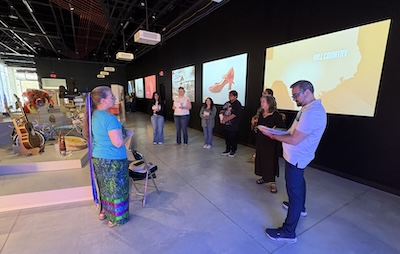
Institute of Texan Cultures docent Ellen Brooker stands beside a Native American drum, greeting visitors in the Chickasaw language, one that many don’t recognize. Some pause, curious, leaning in to listen more closely.
Chickasaw is part of her own heritage. “I like using Chickasaw in my introduction so others can hear it and wonder what I’m saying,” Brooker said. “It helps people understand that Native Americans are still here. If we lose our language, we lose part of our history, culture and heritage.”
Moments like this are part of everyday life at the ITC, where docents turn artifacts into conversations and history into something personal.
While museums house remarkable objects, it’s people who make them meaningful. Docents—volunteer guides found in museums, zoos and galleries—bring out the stories within each piece, transforming exhibits into experiences visitors can connect with.
At the ITC, those connections are central to the mission. Docents engage directly with the public, using artifacts to spark dialogue, invite reflection and help visitors see themselves in the histories of Texas.
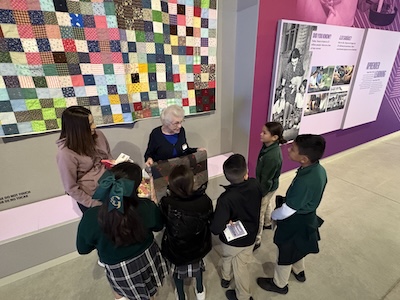
They come from a wide variety of backgrounds. Some are former teachers, military veterans, healthcare and philanthropy professionals, and experienced tour guides. Many have traveled across the country or around the world, bringing diverse perspectives to their interactions with visitors.
“As concepts for the new exhibits emerged, we realized we weren’t just designing spaces—we were influencing the conversations that would happen within them,” said Liz Lopez, the institute’s curator of education. “Our docents stayed deeply engaged, learning new material, preparing fresh ways to share it, and rethinking how to express the institute’s mission.”
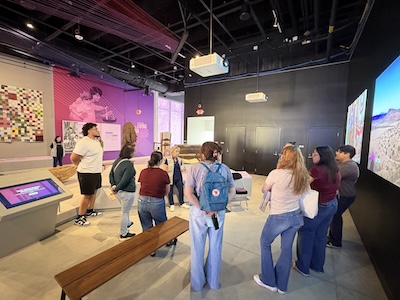
Those ideas now take shape in the galleries, where docents use each object as an entry point for conversation and discovery.
“When we prepare new lessons, we consider each artifact and the context around it—who it belonged to and how it was used,” said Guest Services Manager Kandice Howard-Fambro. “Our docents translate these pieces into lived experiences. They ask questions, invite reflection and help visitors connect the past to their own lives.”
From Teacher to Storyteller
For Brooker, that approach is a natural extension of a lifetime in the classroom. After 32 years as a high school social studies teacher, she joined the ITC as a docent in 2017, looking for a new way to keep teaching.
“I still had an itch to teach, and I saw a notice that the ITC was looking for volunteers,” Brooker said. “Most people think history is boring. I just try to find what interests them.”
She uses these artifacts to open the door to deeper conversations—often weaving in her Chickasaw heritage to make those moments more personal and immediate.
These kinds of interactions—unexpected, personal and grounded in conversation—are what make an ITC visit memorable.
A Second Career: Making Connections
Joanne Duming has seen that connection take many forms. She became a docent in 2009 after retiring from a career in human resources in the medical field, encouraged by a former supervisor who also volunteered at the institute.
Over time, she has taken on a variety of roles, from teaching with hands-on materials in schools as a Texkit docent to supporting administrative work and working on the exhibit floor.
“Kids learn from books and sometimes films,” Duming said. “But it’s incredibly rewarding to see the connection when they can hold a piece of buffalo hide or a drum in their hands. Their eyes light up when something they’ve only read about becomes real.”
With adults, that connection often looks different. Standing near displays featuring quilts or musical instruments, Duming invites visitors to reflect on their own lives—what they grew up with, what their families used every day. As they share those memories, the distance between past and present begins to fade.
“Almost everyone who visits us relates to some aspect of at least one of the cultures that make up Texas,” Duming said.
As the institute prepares to welcome a new class of docents, it’s looking for people who enjoy talking with the public and sharing Texas history with school groups, tour audiences and daily visitors.
"We are truly fortunate to have such an amazing team of dedicated docents," said Monica Perales, the institute's associate vice provost. "They have been and will continue to be critical to our mission to create a place where people feel connected and inspired. They are really the heart of the ITC."
Anyone interested in becoming a docent at the Institute of Texan Cultures must pass a background check and complete compliance training through UT San Antonio. To apply, email texancultures@utsa.edu.