“The people of Texas are informed that, in accordance with a proclamation from the Executive of the United States, all slaves are free. This involves an absolute equality of personal rights and rights of property between former masters and slaves … ”

General Gordon Granger
From General Order Number 3
Read June 19, 1865 in Galveston, Texas
Juneteenth commemorates the arrival of Union soldiers in Texas to enforce the Emancipation Proclamation, setting a new way of life into motion. Freedmen and women could begin living on their own terms. There would be hardships ahead, but by coming together, they laid the foundations of community in places of faith, learning and action.
In San Antonio's case, that foundation was literal. A remarkable discovery along San Pedro Creek revealed the original site of St. James AME Church, one of the city's earliest centers of Black community life. There, newly freed African Americans built not only a church, but a place where faith, culture and civic engagement could take root and flourish.
Six years ago, as a worker from Sundt Construction began jack-hammering through parking blacktop, he hit a limestone foundation and stopped. Despite the project’s tight schedule, the worker paused and alerted project managers about the discovery.
The next day, Jim Campbell, a San Antonio River Authority board member, went to the site in work boots, hard hat and high-visibility vest to see what the workers had found: a limestone foundation and a cornerstone reading “AME Church 1875.”
“Nothing gets a historian going like letters and numbers etched in stone,” Campbell said, at a dedication ceremony for the St. James AMEC Culture Crossing on San Pedro Creek.
This was the original location of the St. James African Methodist Episcopal Church (AMEC) in San Antonio. It had been a parking lot behind the Alameda Theater, directly across Houston Street from the UT San Antonio Institute of Texan Cultures. Since the museum began moving into its new space, staff members have watched the site take shape.
Founded during Reconstruction, St. James AMEC became one of the most influential African American institutions in San Antonio, serving as a center for worship, education, civic engagement, and community leadership.

As part of San Antonio’s Juneteenth celebration, the St. James AME community, San Antonio River Foundation, Bexar County and community partners gathered to dedicate the new public space, opening an artistic installation and gathering place on San Pedro Creek.
The San Antonio River Foundation, a partner in the Cultural Crossing project, described on its website how the church was a hub for political participation, education, civil rights, public service and economic development. It was also home to the first all-Black fire company, and the first lodge of Free Black Masons. The congregation has produced numerous leaders in the AME Church, founders of educational institutions, civil servants, and leaders of civic organizations.
The St. James AMEC Culture Crossing site recreates the original church footprint. Artist Gordon Huether created “Presence of the Past,” an artistic installation defining the original footprint of the church. The installation features white steel facades, laser-etched in patterns reminiscent of “freedom quilts” often used to convey messages to African Americans escaping slavery.
“I wanted to create a space that was educational, was inspired, had a spiritual dimension to it, that made you feel like you were in a sacred place,” Huether said.
At the location of the original altar, a steel plate has been etched with the names of 300 original and early congregants.
San Antonio Poet Laureate Emeritus Andrea “Vocab” Sanderson joined Gordon Huether’s team, adding a voice of the African American community to the project. In studying the site’s history, historians discovered its owners prior to the congregation: Klemke-Menger Soap Works. Her composition, “Suds to Salvation,” describes a place where soap was made to cleanse the body and a church was made to cleanse the spirit. The composition is laser-cut into a shade structure in the plaza adjoining the original church footprint.
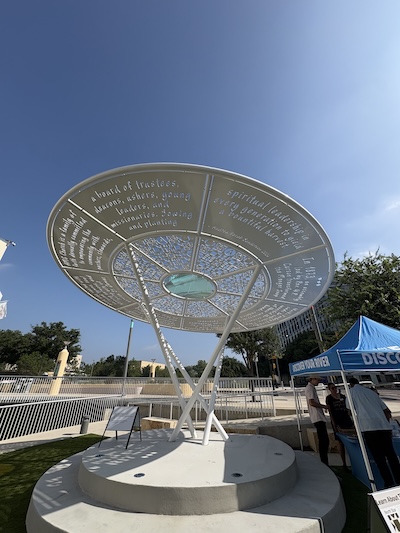
The June 18 dedication of the St. James AMEC Culture Crossing was part of a larger Juneteenth celebration. The day began with praise and worship led by the congregation’s choir. Pastor Cynthia Ladson, in her opening invocation, remarked, “God, you are intentional in everything you do.” The opening of the Culture Crossing is another sign of life and culture returning to this part of downtown.
Bexar County Judge Peter Sakai spoke at the dedication, noting that alongside new educational, residential, and commercial developments, the Culture Crossing ensures that downtown’s revitalization honors the history and communities that helped shape San Antonio.
Sakai oversaw the final stages of the project and, at the dedication event, recognized the work of former County Judge Nelson Wolff and Commissioner Paul Elizondo, who initiated it. Sakai recalled that this section of San Pedro Creek had long been a drainage ditch laden with trash. The county invested $301 million in the San Pedro Creek project, transforming a neglected drainage channel into a pubic space designed to connect communities and celebrate local history.
“What makes this site especially remarkable is that it reflects the many communities that have contributed to San Antonio’s unique identity,” Sakai said, “from the German immigrant entrepreneurs who established the region’s first commercial soap factory, to the African American congregation that transformed this location into a beacon of faith and freedom. This site represents the interconnected story that defines our city.”
The story of St. James AMEC is also a Texas story — one of faith, perseverance, leadership, and freedom. As Juneteenth reminds us, the history of Texas is shaped by many communities whose contributions continue to influence the state today. Preserving and sharing those stories remains at the heart of the Institute of Texan Cultures' mission to explore and celebrate the diverse people and cultures that define Texas.